

Breaking Free from Purity Culture: The Gospel of Grace
|
Getting your Trinity Audio player ready...
|

THE IMPOSSIBLE STANDARD AND THE FREEDOM OF GRACE
If purity culture taught us anything, it’s that we can turn even the gospel into a performance review.
We trade one set of rules for another.
We swap the freedom of Christ for endless self‑inspection.
We obsess over our failures and then wonder why nothing ever changes.
But Jesus never invited us into a new form of religious perfectionism.
He came to expose the impossibility of saving ourselves — and to free us from the burden of trying.
—
Jesus and the Impossible Standard
Jesus sets the standard for holiness impossibly high — deliberately so.
In Matthew 5 He says:
“Unless your righteousness surpasses that of the Pharisees… you will certainly not enter the kingdom of heaven.”
The Pharisees were the gold standard of moral performance. They could quote the Torah from memory. They obeyed every rule they could find. And Jesus still said it wasn’t enough.
Then He goes further:
• Hidden anger is the moral equivalent of murder.
• A lustful glance carries the weight of adultery.
• A careless insult reveals a heart capable of violence.
And then the final blow:
“Be perfect, therefore, as your heavenly Father is perfect.”
Jesus doesn’t raise the bar from “be a decent person” to “try a little harder.”
He raises it to the flawless holiness of God Himself.
Anyone listening that day would have felt the same thing many of us felt after purity culture:
This is impossible. I can’t do this. I’ll never measure up.
And that reaction is exactly what Jesus intended.
—
Why Would Jesus Do This?
Why preach a sermon no one could obey?
Because He wasn’t giving us a new law to master — He was revealing that we never could.
The purity movement stopped at the command. Jesus wanted us to see the context.
He says:
“I have not come to abolish the Law… but to fulfill it.”
In other words:
You can’t climb this mountain — but I can. And I will.
Paul picks up this theme in Romans 8:
• The law could diagnose sin, but it could not cure it.
• Our flesh was too weak to meet its demands.
• So God sent His Son to fulfill the righteous requirement for us.
And in Galatians 3 Paul explains why the law was given:
• Not to save us
• Not to make us righteous
• But to imprison everything under sin so that Christ could set us free
He drives the point home:
“If righteousness were through the law, then Christ died for no purpose.”
Jesus didn’t raise the standard to crush us.
He raised it to drive us to grace.
—
The Freedom of Grace
So does grace mean anything goes? Does freedom in Christ give us permission to sin?
Paul’s answer — and Jesus’ answer — is a resounding no.
But the reason matters.
We don’t avoid sin because we’re terrified of failing a divine performance review.
We avoid sin because Christ’s perfection has already removed the pressure, and the Spirit is now reshaping our desires from the inside out.
Romans 8 says the “law of the Spirit of life” sets us free — not just from guilt, but from sin’s power.
Romans 6 says sin no longer has dominion over us because we are “not under law but under grace.”
Grace doesn’t weaken holiness.
Grace creates holiness.
The difference between purity culture and the gospel of grace couldn’t be clearer:
—
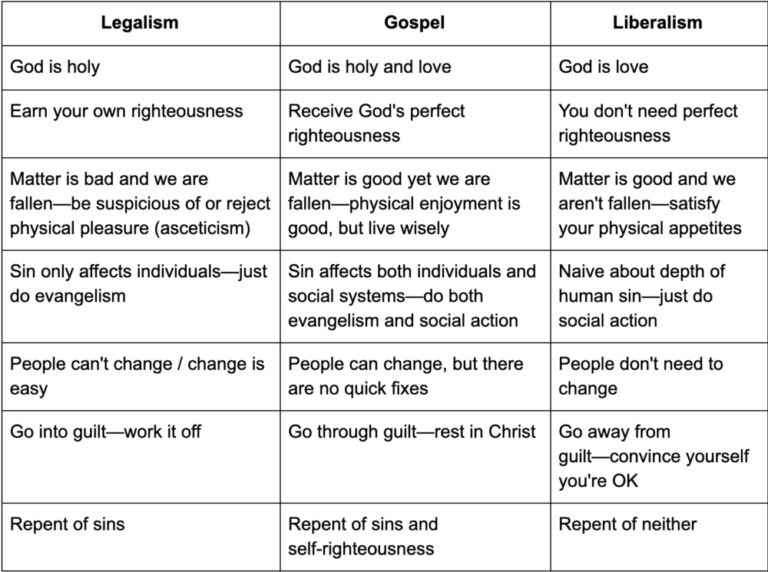
—
Paul’s letters make this painfully clear.
The Corinthian church was a mess — sexual sin, gluttony, gossip, chaos. Paul confronted all of it, but he did so patiently, reminding them:
“All things are lawful for me, but not all things are helpful… I will not be dominated by anything.”
He wasn’t giving permission to sin.
He was reminding them that sin is slavery, and grace is freedom.
Meanwhile, Paul’s harshest words weren’t for the morally chaotic Corinthians — they were for the legalistic Galatians.
Why?
Because legalism destroys the gospel at its root.
Paul says in Romans 6:
“Are we to sin because we are not under law but under grace? By no means!”
And in Romans 12 he describes the real engine of holiness:
transformation by the renewal of the mind — not fear, not shame, not rule‑keeping.
Grace doesn’t lower the bar.
Grace changes the heart.
—
The Weights Are Off
Sin is still a reality in our lives — but it no longer owns us.
The flesh is loud, but the Spirit is stronger. And when we fall, Christ doesn’t shame us. He lifts us up, dusts us off, and sets us back on our feet.
Shame doesn’t help you.
Obsessing over your brokenness doesn’t help you.
Even the sin itself doesn’t help you — it gives you a terrible return on investment.
So why cling to it?
The law, by contrast, only multiplies shame. It turns your gaze inward, trapping you in the belief that you will never be enough. And that is exactly the enemy’s strategy: to drown out the voice of the Spirit with the noise of your own failure.
Paul warns in Ephesians not to grieve the Holy Spirit — not because our salvation is fragile, but because our relationship with God is tender.
It’s like a marriage. The covenant is secure, but your choices still affect the intimacy.
And this is why legalism fails every time.
A million rules cannot make you holy.
Shame cannot make you holy.
White‑knuckled self‑improvement cannot make you holy.
Only Christ’s goodness can do that — and He has already done it.
So let the chains fall off.
Lift your hands in worship.
And let God change you from the inside out.
—
Where the Spirit of the Lord Is, There Is Freedom
Hebrews 12 invites us to lay aside every weight — not by trying harder, but by fixing our eyes on Jesus, the Author and Perfecter of our faith.
And 2 Corinthians 3 tells us that the old covenant brought condemnation, but the new covenant of the Spirit brings life, glory, and freedom.
When we turn to Christ, the veil is removed.
When the Spirit is present, freedom is present.
And as we behold the glory of the Lord, we are transformed “from one degree of glory to another.”
This is the answer to purity culture.
Not moral chaos.
Not a new set of impossible rules.
Not shame dressed up as holiness.
The answer is Christ.
Not less holiness — but a different source of holiness.
Not endless self‑condemnation — but transforming grace.
Not a million rules — but a relationship with the One who fulfilled every requirement we never could.
So the chains can come off.
The performance reviews can end.
The veil can be lifted.
Where the Spirit of the Lord is, there is freedom.


